
26th February, 2026 • 4 mins
Avoid this common pitch presentation mistake
Written by Mimi Village
10th April, 2026 •

Think of a time when you’ve needed to persuade someone of something during a presentation or pitch. Maybe you were trying to change your colleagues’ opinion on climate change during a board meeting. Influence your manager to give you a pay rise during an annual review. Inspire your team on an upcoming change. Or persuade a client to sign the dotted line during a pitch.
Most of the time we stop at what we want whoever is across from us to THINK and DO – ‘I want them to think my product is amazing so they want to buy it’. We want them to take action and hand us that promotion. We want to close the deal.
But here’s the thing that we might miss – around 80% of human behaviour is driven by emotion!
So the real question is: how do we want them to feel?
Imagine this emotional journey through your pitch:
There are different ways to create this emotional journey, we want to think about the words we are saying, read our blog on how to shape the content so it is as impactful as possible.
And interestingly, in ‘emotionally charged’ communication (presentations or conversations that elicit emotions), it’s been found that only about 7 % of meaning comes from words, while 38 % comes from vocal tone.
What drives action arguably isn’t just the words we say, but HOW we say them.
Voice is what carries the emotional arc of our audience.
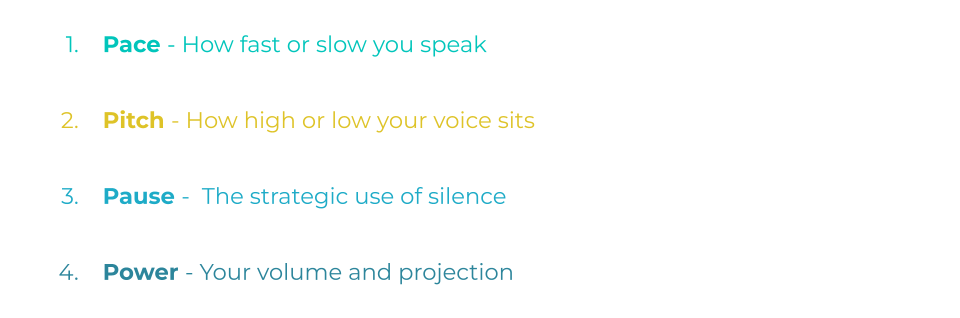
For example:
Most of us default to one setting, especially when we’re under pressure. This is when we might slip into common pitfalls such as, rushed delivery, upward inflection or tight breathy tone that can sound quite nasal.
Think of two people delivering the exact same message.
One is monotone, rushed, and flat.
The other slows down where it matters, lifts their tone on key points and uses pauses to draw you in.
They could both be saying the same words – but which would resonate with you more?
Here is a tool we’re going to work through to ensure your messages land with impact.
Follow this simple 3 step tool to map out how you can use your voice ahead of your next pitch or presentation. This still works within the context of calls where it is a two way conversation.
Try it out right now, think of a presentation or pitch you have coming up, write the name of this at the top of your page.
What are the different sections of your presentation?
This could be as simple as beginning, middle, end.
Take a moment to break down your presentation into sections and write these along the top of the page, for example:

What do you want your audience to feel at each stage?
Question prompts to help thinking:
Write a few words that describe what you want your audience to feel at each stage, look at the example below.
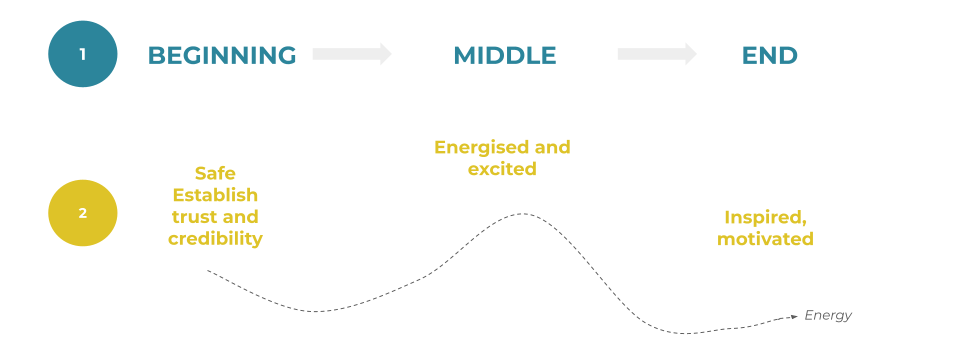
How can your voice create this emotion?
At each stage think: How can I use my pace, pitch, pauses and power to elicit this?
Start by focussing on 2 vocal levers you can pull on for each stage and write them down
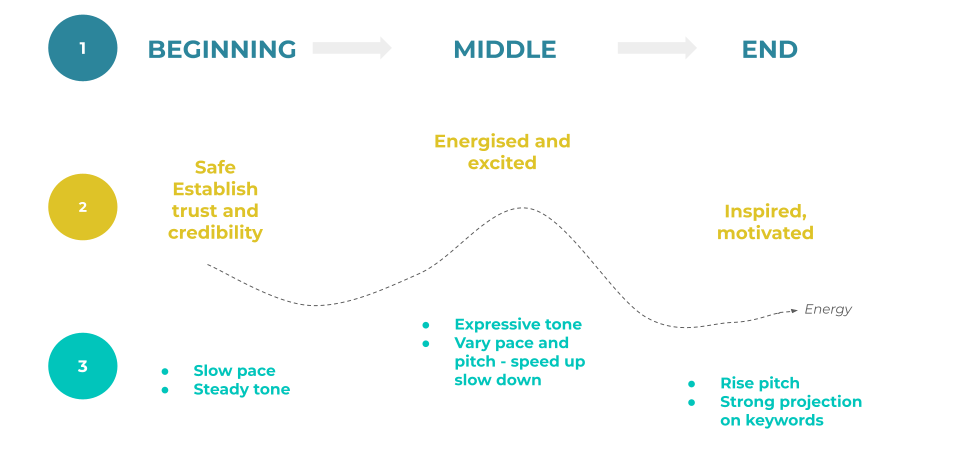
Below is a bank of how you can use these vocal levers in practice. Choose two per section, and practice how this feels on your voice – experiment! Take a moment and write down one goal for each stage.
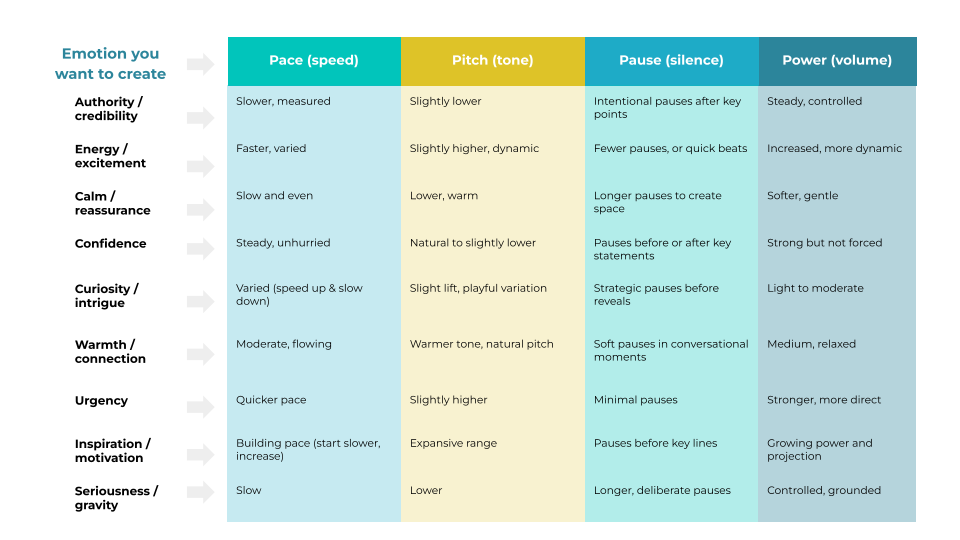
Practice saying this sentence out loud:
“What we’re proposing today is a simple and practical way to move forward with confidence, make better decisions, and ultimately achieve stronger, more consistent results.”
Now try it three different ways:
Version 1 – Authority:
Imagine you’re in a high stakes meeting. Maybe a board room or senior stakeholder call where time is tight and people are sceptical. They want clarity rather than a fluffy warm message.
This is where you need to signal “I know what I’m talking about. You can trust this”
Try this:
Slow your pace. Lower your pitch slightly. Be intentional with every word. Add a deliberate pause before: “and ultimately achieve stronger, more consistent results.”
Version 2 – Excitement:
Maybe your next pitch is an idea you really believe in, that you want to get a client excited about. Need that visionary approach and energy to create momentum.
Try this:
Increase your energy, lift your pitch, and add emphasis on “simple” and “practical.”
Version 3 – Warmth and connection:
Maybe you’re speaking to people who feel uncertain or overwhelmed. It could be a new change initiative that is being introduced or maybe the team has been through a lot recently. Your voice needs to say ‘I understand, we’re in this together’
Try this:
Soften your tone, smile as you speak, vary your pitch and allow conversational pauses between phrases.
Notice how the same words create completely different feelings depending on how you use your voice.
We would recommend recording yourself and playing it back, use the recording to see how effective using the levers are at creating your intended emotion, play around with how a slow pace affects credibility or how to build excitement with raising your pitch for example.
And it might feel awkward at first – trust me, we know! But it really is worth it.
Here’s what a more complex example of a presentation flow could look like using this tool:
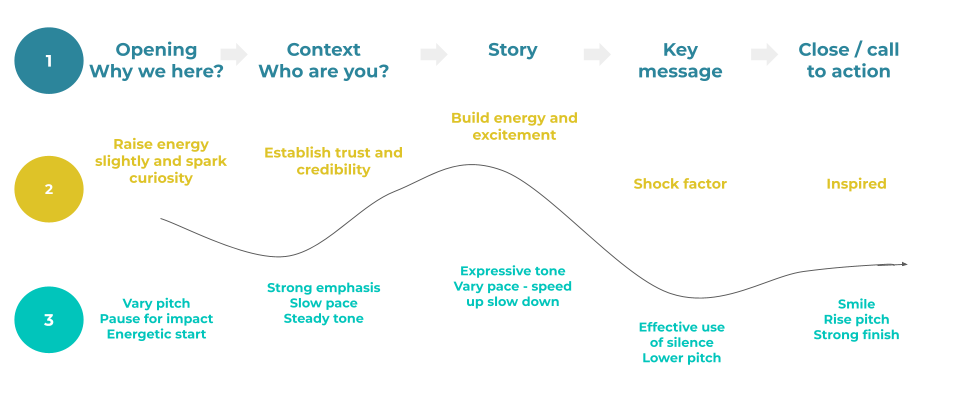
If in doubt: slow down, pause more, and vary your tone. Most people need less speed and more intention, rather than more words.
How many pitches, presentations, conversations even, have really stuck with you? Most likely it’s those that have made you feel something.
One final quote to leave to you with from Maya Angelou…
“People may forget what you said, but they will remember how you made them feel.”