
10th January, 2024 • 5 minutes
5 strategies to successfully align expectations
Written by Em Roberts
27th May, 2026 •

Why did Nokia, Blockbuster, and ToysRus fail?
Because they didn’t embrace change.
Change is a hot topic at the moment, and many of our clients are navigating the highs and lows of new strategies, restructuring, shifting priorities and evolving roles. Change is important but often uncomfortable. We can find it hard to navigate the shifting priorities, responses and messages.
And yet, when change fails, we often blame the strategy.
In our experience, that’s rarely the full story. That’s why we run change communication workshops. And this blog will provide a snapshot of what our work can look like.
Does this resonate with you?
You’ve been asked to roll out a new client first change initiative. On paper, it’s compelling. A clear set of behaviours and a simple framework designed to help prioritise client needs in every decision.
In presentations, it seemed to land well. The team were always keen to focus more on the client, and this seemed to unlock just that.
But when the slides were translated into daily conversations, something shifted.
You struggled to translate the deck into real-life examples that resonated. Leading the team to ask themselves,
Feeling overwhelmed and under-equipped for these answers, you fell silent. Instead of gaining clarity, they felt confused.
Why is that! We often see this in our programmes where a change has remained surface-level. This means that initiatives lose momentum and ultimately fail to deliver the intended impact.
If this example has resonated, you’re not alone. We’re going to introduce a tool that has provided some real ‘aha’ moments in our programmes and led to longer-term impact as teams’ understanding of a change increases, leading to greater engagement and buy-in. This effect on the manager is significant as it makes change communication more efficient. An example of this in our work is a recent innovation and change module with a bank, where managers were trying to connect the day-to-day changes with the wider strategy.
Say hello to the Change Story.
A simple yet effective tool to help communicate change to your team. By communicating change through storytelling, we can make it easier for our team to clarify their role within the change, increase confidence and connect them to the benefits.
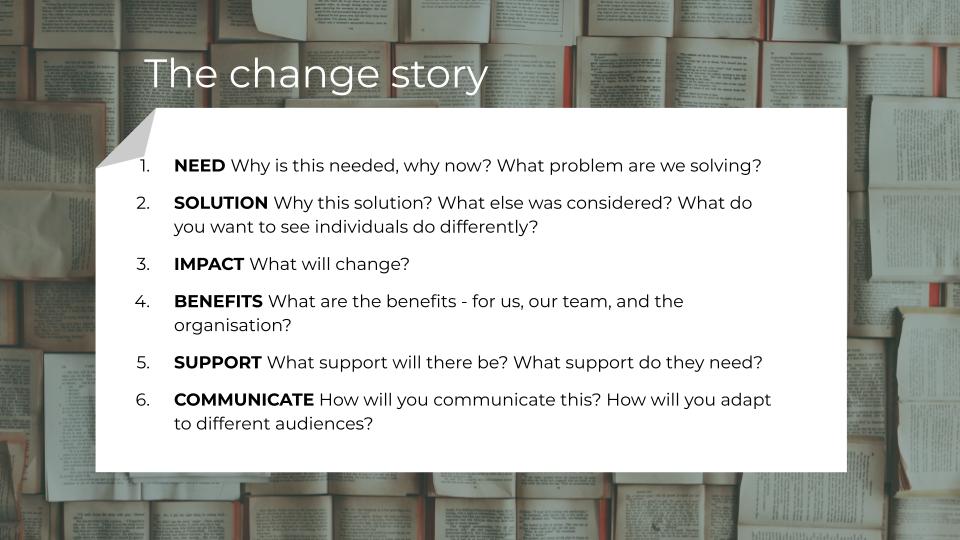
Think of a change you need to communicate, or reflect retrospectively on a recent change initiative you led through.
Pick your audience or specific stakeholder – who are you communicating this to? Are they stakeholders? New starters? Middle managers? How will you adapt your message based on their needs? Keep asking yourself how you want the team to feel and see how that influences your message.
Use this structure to build or review your change narrative to that specific audience.
Tip! As you move through this 6-step process, consider your audience.
Humans don’t change unless they understand the why. A mistake we often see is leaders forgetting to share the why behind the change, or even not fully understanding it themselves. If people are hesitant about a change, they’ll usually want to really understand the purpose behind it. If you’re not fully clear yourself, it’s worth going back to the source and asking more questions so you can explain it confidently when needed.
2. SOLUTION Why this approach? What else was considered?
For your team, this change might seem to have appeared out of the blue. It could appear like someone in leadership has decided, ‘we’re going to pivot’ on a whim.
In reality, multiple options were likely debated, with multiple stakeholders involved, before landing on this solution. It’s not a random change; it’s a strategic decision. By sharing ‘why this approach’, we help the team to get on board with the change. This is especially important when ideas have been contributed by the team, as they may feel deflated if their idea is not chosen.
3. IMPACT What will change for us / our team / the organisation?
What will the change look and feel like day-to-day? This is where uncertainty can manifest. Without painting a clear picture of what behaviours are expected to change, individuals will fill in the gaps themselves, making assumptions and different interpretations of the same message.
Even if you don’t have the full picture, name the uncertainty. And outline what behaviours/priorities to focus on in the shorter-term.
A mistake that can be made is thinking “I’m not sure about this/don’t have the full picture, so I won’t share it until I know more, and it risks impacting my credibility”. Sharing the uncertainty and involving your team at a potentially earlier stage in the change process can be a really valuable way to build trust and psychological safety.
4. BENEFITS What is in it for us/you?
Look out for another common mistake here! When talking about the benefits of a change, many leaders focus on how this will positively impact the organisation. This is important, but our team members will also want to know how they can expect to benefit.
We know from loss aversion theory that we feel losses almost twice as much as we feel gains. Here, it is really important to think about the benefit to the audience to outweigh the natural aversion to uncertainty. It could save time and remove clunky processes. What do they care about, and how can you link this to the change? To keep your message clear and powerful, use the rule of three – one of the oldest, most effective rules of communication. Condense the benefits of the change into three powerful reasons, tailored to what your audience cares about.
5. SUPPORT What support will there be? What support is needed?
We often see leaders forgetting to communicate that they will be there to support. Here you want to step forward and reassure. Remember how you felt when you first heard about the change and what support you needed in order to process and implement the actions needed. Take time to think about who you are communicating this change to and consider how the support they need might be different. For example, someone more risk-averse may need more reassurance or a detailed roadmap of the initiative and support at each stage. Or someone who will need to upskill in a certain area may need reassurance that the appropriate support will be provided.
6. COMMUNICATION How will you adapt the way you communicate the change to different audiences?
This is really important and has often been a light-bulb moment in our workshops on effective change management. Different audiences will need you to lean in and adapt your communication at different points. For example, adapt to the different behaviour styles in your audience. Some may not feel they need support, but will really want to understand the benefit. Whilst others may feel nervous about adapting to new requirements, and will want you to provide more clarity and context before getting on board.
There is no one size fits all approach when it comes to the change story. Effective change communication requires you to flex your style, level of detail, and even tone depending on your audience.
Change needs to be communicated more than once. Without a clear communication cadence, teams can quickly lose momentum and default to old habits.

To stay anchored to the change, ask yourself:
There’s a reason why we run dedicated workshops to effectively communicate change. Because it is hard. But by equipping your toolbox with strategies such as the change story, you will find that you gain greater clarity in your communication, not just for yourself, but also for your team.
Sparked your interest? Why not get in touch to see how we can help you communicate through change.