
28th February, 2024 • 5 mins
How to adapt your leadership style
Written by Mimi Village
31st July, 2026 •

Maybe it’s someone who puts out the fires, corrects mistakes, makes brilliant, quick decisions, knows the ins and outs of everything that’s going on all the time, reliably comes to the rescue. The hero.
Many leaders have been rewarded throughout their careers for being the person with the answer. Their expertise, responsiveness and willingness to help are often exactly what earned them a leadership role.
Then their responsibilities grow.
Their calendar fills up. Their Teams notifications never stop. They move between back-to-back meetings, answering questions, approving decisions and stepping in whenever something goes wrong.
“I just don’t have enough hours in the day.”
It’s something we hear from leaders almost every week.
On paper, they’re doing exactly what great leaders are supposed to do. But what if all of that ‘being helpful’ is actually stopping your team from growing?
If YOU are constantly firefighting, how are your team supposed to know what to do when there’s a fire that they don’t know how to put out?
If the leader makes every decision, how will the team learn to make the best decisions?
A recent Gallup report shows only 1 in 5 employees are engaged, and that low-autonomy environments correlate strongly with disengagement and reduced ownership. When teams wait for permission, momentum dies. Permission-seeking replaces psychological safety.
Beyond this, we are living in a world that is constantly changing, the goal posts are forever shifting. If leaders are spending most of their time in meetings they don’t need to be in, making decisions they don’t NEED to be making, they don’t have the time, or head-space to focus on strategic direction.

When Harvard leadership experts Ronald Heifetz and Marty Linsky published their book “Leadership on the Line” in 2002, they described adaptive leadership through the metaphor of the ‘dance floor and balcony’. It illustrates how leaders need to metaphorically be active in adopting a strategic perspective (head up to the balcony), while remaining connected to their daily workload and understanding what is happening on the front line (the dance floor). The ability for leadership teams to perceive, observe and intervene by moving between the dance floor and the balcony reflects how successful they will be in dealing with changing priorities.
By pausing and looking at the bigger picture you notice patterns, power dynamics and recurring challenges that aren’t always visible when you’re in the weeds.
When Satya Nadella became CEO in 2014, Microsoft was known for internal competition. Teams protected information, departments competed with each other and many decisions flowed upwards.
Rather than positioning himself as the visionary with all the answers, Nadella focused on changing the system.
He introduced a culture centred around a “learn-it-all” mindset rather than a “know-it-all” mindset. He encouraged collaboration across teams, psychological safety and continuous learning. This is known as a ‘systems leader’ approach.
Microsoft (as we now know) became one of the world’s most valuable companies again, employee engagement increased dramatically and innovation accelerated with products like Azure and Co-pilot.
Systems leaders are intentional: they design environments where organisations thrive without them, they learn to let go.
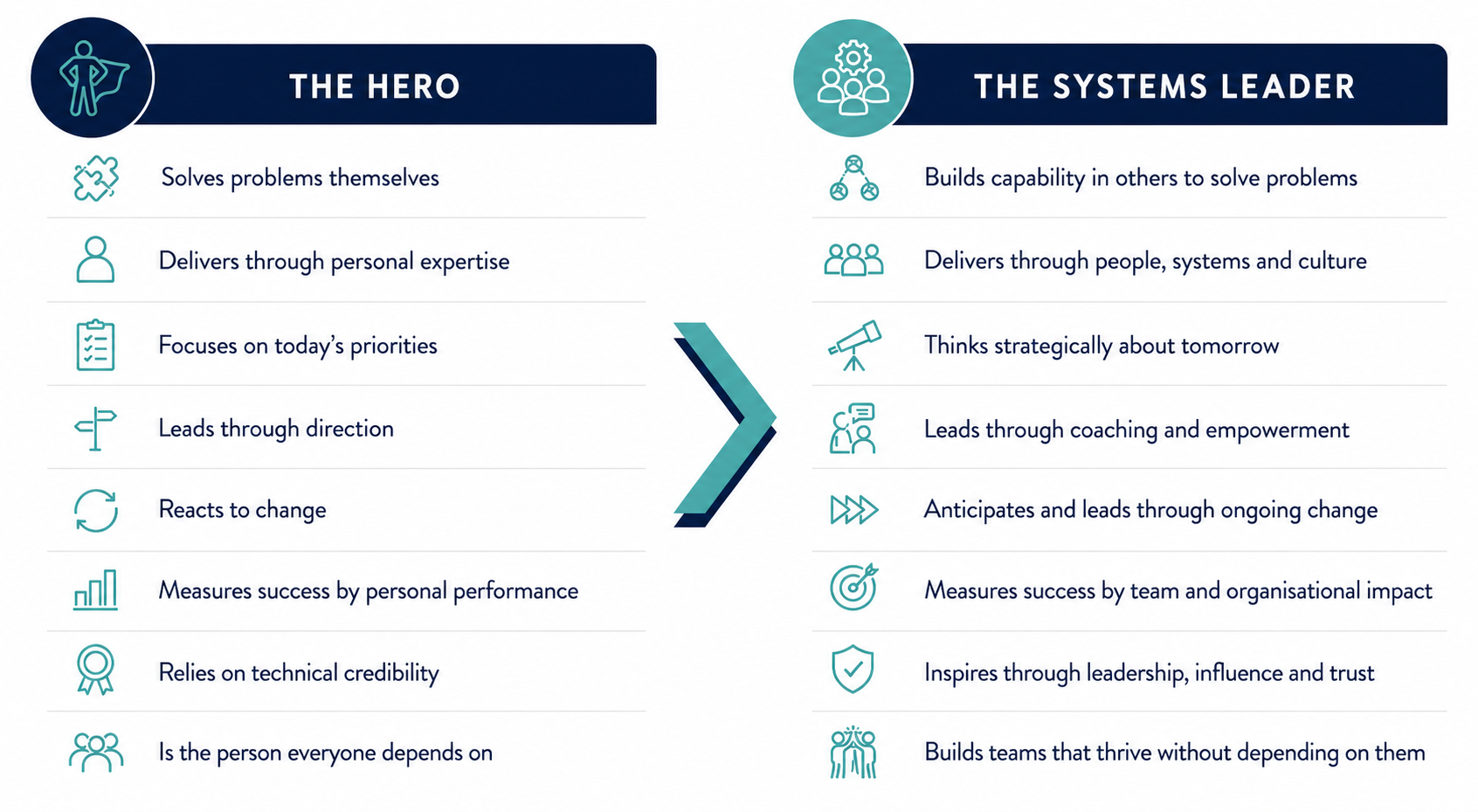
The shift starts with awareness, we first need to notice where it’s happening.
Before reading any further, I’d encourage you to do something…
Open your calendar for this week and ask yourself one simple question:
How much of my diary is filled with things that only I can do?
Not things that you’re good at, not things that you enjoy, things that genuinely couldn’t happen without you.
You might notice meetings you’ve accepted out of habit. Approval requests that have become routine. Decisions that someone else could probably make. Conversations where you’ve instinctively stepped in to solve a problem, rather than coaching someone through it.
Being intentional about how you lead starts with being intentional about where you spend your time. The more time you spend on work that others could own, the less time you have to think strategically about the work that only you can do.
Use these prompts to deepen your thinking:
It’s a deceptively simple exercise, but it often leads to one of the biggest lightbulb moments in our leadership programmes. When we ask a room full of leaders this question, there’s usually a pause, followed by a few nervous laughs. It’s often the first time they’ve realised just how much of their week is taken up by work that could become someone else’s opportunity to grow.
When leaders tell us they’re constantly firefighting, making every decision or answering every question, it’s rarely because they’re trying to micromanage.
Usually, one of four things is happening.
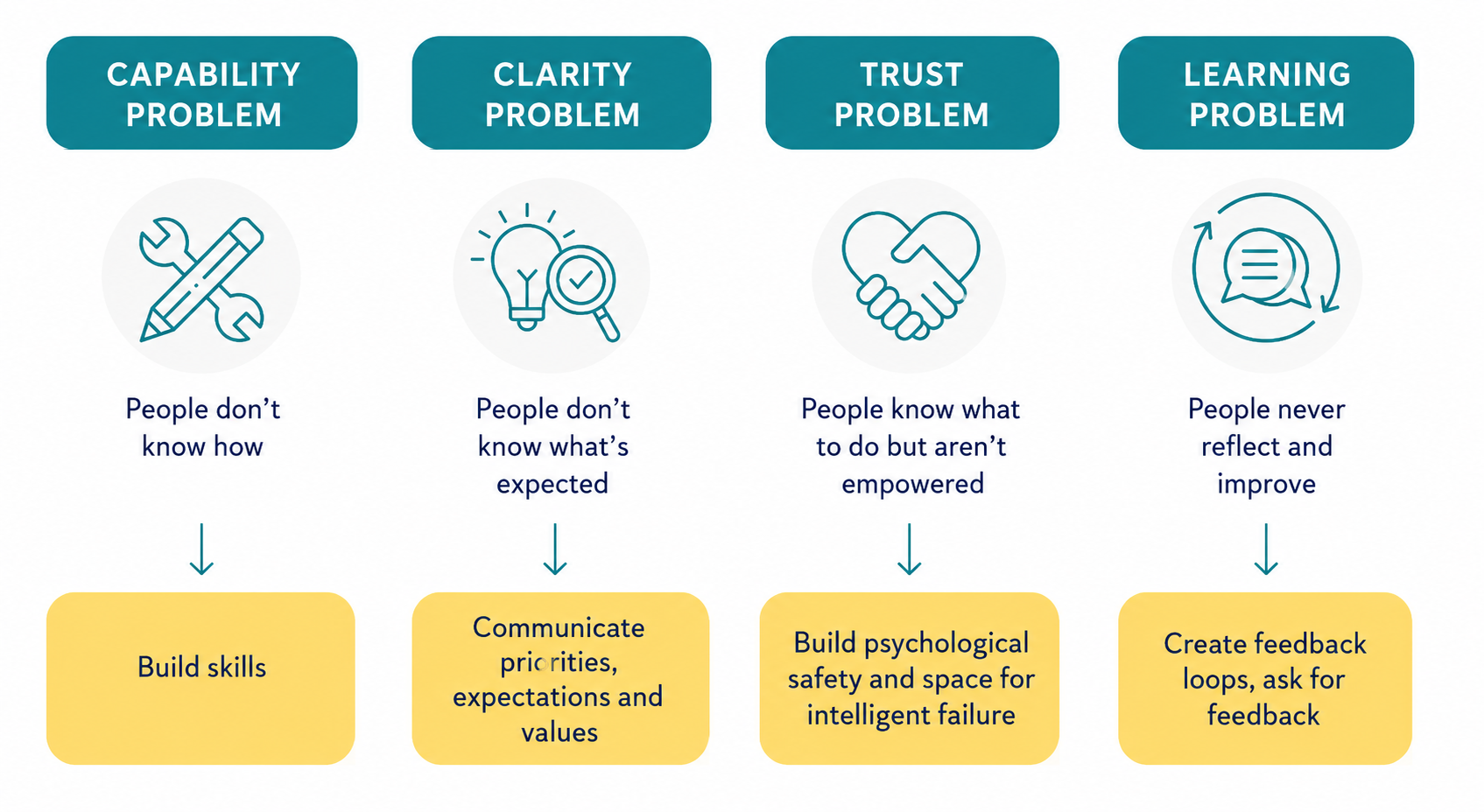
Sometimes people genuinely don’t know how.
Perhaps they’re new to the role, taking on a new responsibility or simply haven’t had the opportunity to develop the skills or confidence yet. In these moments, stepping in might solve today’s problem, but it won’t solve tomorrow’s.
Systems leaders resist the temptation to become the expert every time. Instead, they coach, ask questions and create opportunities for people to learn by doing. It often takes a little longer in the short term, but it builds capability that lasts far beyond the task in front of you.
The next time you find yourself jumping in, ask yourself:
Am I solving this because they can’t… or because it’s quicker if I do?
Read our blog on how to have coaching conversations that empower teams.
As leaders, we often carry far more context in our own heads than we realise.
A leader recently shared in a workshop ‘You get bored of your message FAR before your team do’ – correct.
We know the history, the nuance and the bigger picture, but our teams don’t.
Systems leaders don’t just communicate more; they communicate with greater clarity. They help people understand the ‘north star’, the outcome they’re working towards, what good looks like as well as where they have the freedom to make decisions for themselves – empowering them.
Read our blog, Communicating through change, we share the ‘change story’ tool to effectively communicate and align your team to strategic priorities.
Sometimes people know exactly what to do, they just don’t feel safe enough to do it.
When every tiny decision is checked, every mistake is criticised or every solution is overridden, people quickly fall in line and learn that it’s safer to ask than to act and over time, creating an ‘approval-seeking’ culture.
Systems leaders create environments where people feel trusted to use their judgement, test ideas and take intelligent risks (which don’t always work out).
One of the ways to build trust that we often see is actually celebrating failure, recent research from Amy Edmonson shows the value and importance in creating space to fail. Read our blog for practical strategies on how to encourage intelligent failure to drive innovation.
As the famous Thomas Edison quote goes…
‘I have not failed. I’ve just found 10,000 ways that won’t work’
We get a nice hit of dopamine when we solve a problem, get to the finish line of a hard project, or complete a tight deadline on time – moving on from it feels good so we often miss the opportunity to ask: Why did this happen, and what could we do differently next time?
Systems leaders build feedback loops into the way work happens. They create regular moments to pause, reflect and improve, through project retrospectives, mid-point check-ins and team conversations about what’s working and what isn’t.
They also ask for feedback in a way that makes it easier to give. Something we are often guilty of is asking “any feedback for me?”, if you’ve tried this you’ll be familiar with the silence that follows.
Instead ask: “What’s one thing I could do differently that would make it easier for you to succeed?” “Where could I do more of or less of around X?’
The quality of the feedback you receive depends on the quality of the question you ask. Read our blog on how to ask for feedback for more on this.
Building systems leadership is about becoming more intentional.
It’s choosing to spend your time on the things that only you can do, whilst creating the conditions for everyone else to do their best work. It’s stepping away from solving every problem yourself, so that your team can build the confidence, capability and judgement to solve them independently.
As we often say at Higson…
If your team can’t succeed without you, you’ve built a hero culture. If they can succeed because of you, you’ve built a system.
Of course, this shift doesn’t happen overnight. Like any leadership capability, it takes awareness and practice.
And if you’re thinking, “This sounds great, but where do we actually start?” That’s exactly what we help leaders and leadership teams do.
If you’re interested in hearing more, get in touch with us at hello@consulthigson.com or connect with the team to explore how we can help you build systems leadership across your organisation.