
27th May, 2026 •
Communicating through change: Why it matters more than the change itself
Written by Coran Lui
15th June, 2026 •

Change fatigue at work can show up before the day has even properly started.
Imagine this: you get into work on a Monday morning, log into your laptop, and open your emails.
*Ding* A new priority shift.
*Ding* Another restructure update.
*Ding* A “quick note” that changes the direction of a project you thought was finally settled.
And that’s before you have even made yourself a coffee.
Does that feel familiar?
If so, you’re not alone. Accenture’s Change Reinvented report found that 95% of organisations have undergone two or more transformations in the last three years. It also found that managers are twice as likely as the C-suite to feel that change is happening too fast.
One change initiative rarely causes burnout. More often, it is the ongoing feeling of needing to adapt without having enough time to reset.
And that’s what change fatigue at work is – it’s the mental, emotional, and physical exhaustion that occurs as a result of experiencing lots of change.
So when teams seem tired, hesitant or frustrated, it’s worth taking a step back before calling it resistance.
It won’t always be as obvious as people vocally pushing back.
It can also be symptoms like lower energy, cynicism, passive compliance, loss of trust, emotional withdrawal, or the familiar sigh of “here we go again.”
Change is a common challenge that comes up in our workshops too.

Recently, in one of our workshops, a participant shared a story that really stuck with us.
They were reflecting on the shift from office working to working from home during COVID. When people heard the news, they were frustrated, uncertain, and saying: “How is this ever going to work?”
But over time, people found different ways to work together, and adapted to the new normal.
Fast forward a few years, the organisation began moving back towards the office. Even though it used to be the norm, the same frustration returned. As did the practical concerns, and the questions about how it would work day to day!
That is the challenge with continuous change. People can adapt brilliantly, but if they keep having to reset without enough clarity, involvement or breathing room, the emotional effort starts to build.
So when someone seems hesitant, cynical or disengaged, they may not be “bad at change”. They may just be tired from going through change again, and again.
Of course, some will naturally be more cautious around risk and uncertainty. But change fatigue is rarely just about individual mindset. Culture plays a huge role: how change is communicated, how involved people feel, how priorities are managed, and whether teams have enough space to recover.
So, how do we navigate this as individuals, leaders and organisations?
In the rest of this blog, we’ll explore practical ways to build a stronger change mindset, support different responses to change, and proactively reduce the risk of change fatigue at work.

When change is happening at pace, it’s easy for leaders to focus on the visible parts: the process, timeline, delivery plan and outputs.
And that is important – but it is only part of the picture. After all, change does not happen on a spreadsheet – it happens through people!
Research shows what organisations that adapt well do differently: they pay attention to how people are experiencing the change, whether they understand it, feel involved in it, have the confidence to act, and have enough space to recover as they go.
And as we explored in our blog on why culture drives performance, the way people communicate, make decisions, build trust and take ownership directly shapes business outcomes.
It makes it more likely for teams and organisations to achieve successful transformations, deliver change on schedule, improve cost savings, and report higher revenue growth. They are also more likely to improve employee wellbeing, trust and engagement.
In other words, the strongest change cultures improve performance and people experience at the same time.
So what actually helps people navigate change more effectively?
There are lots of useful models for behaviour change. When it comes to change at work, we find they often come back to four simple areas: awareness, motivation, capability and opportunity.
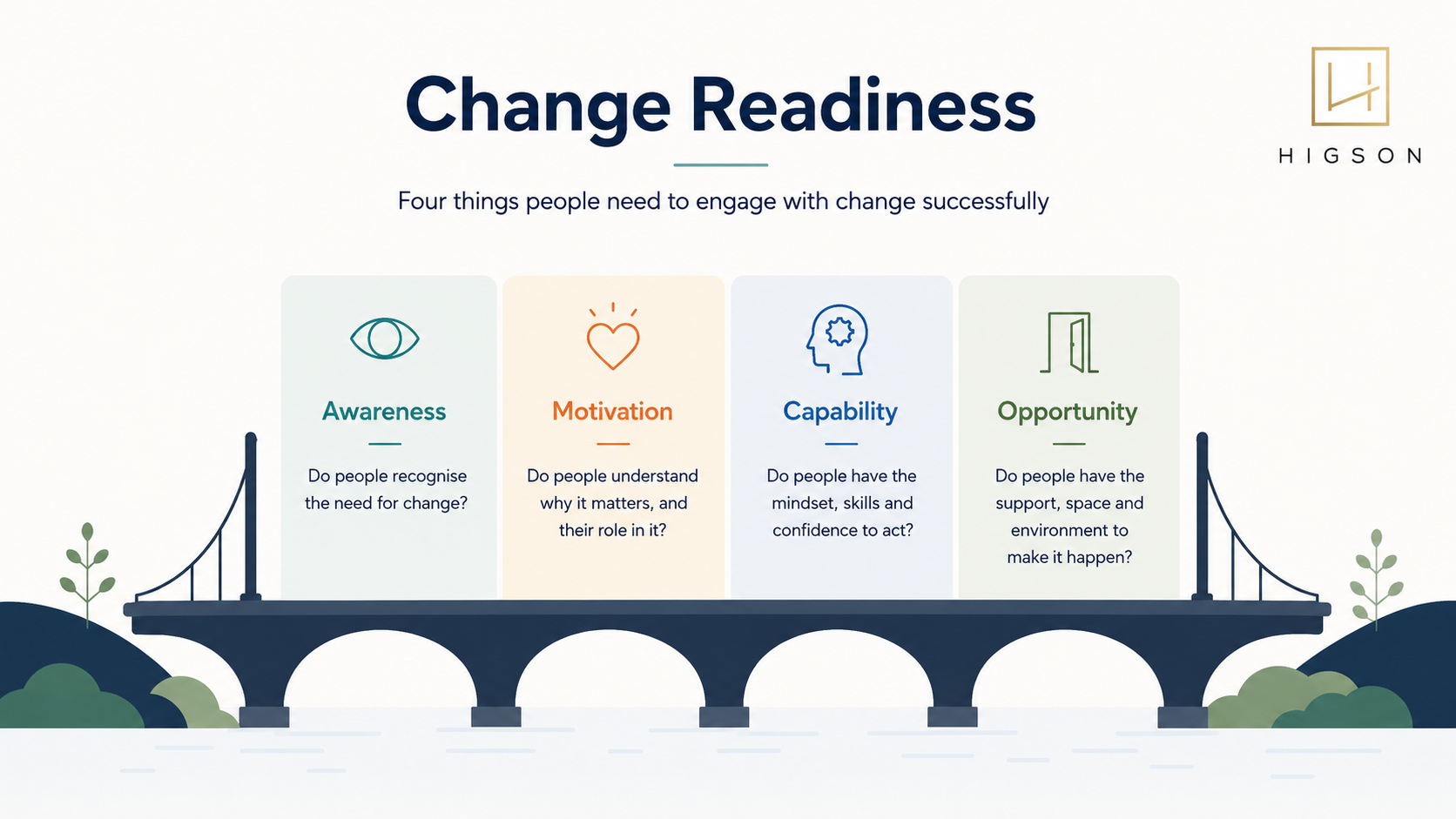
We can think of these as the foundations of a bridge.
If one part is missing, the journey becomes harder. People might understand the change, but not feel motivated by it. They might believe in the direction, but not feel capable enough to act. Or they might be ready to change, but feel like they don’t have the opportunity to put it into practice.
Let’s explore all four in more detail, so we can spot where the bridge may need more support, and how to offer it.
We are more likely to engage with change when we understand why it is needed. Without that awareness, change can feel sudden, confusing or disconnected from the reality of our work.
A useful starting point is to check what people have actually understood. For example:
This is especially valuable during uncertainty, because as humans we are programmed to notice the potential risks (or losses) first: more work, less control, new expectations, familiar ways of working changing.
Although these worries are often valid, leaders can help people see the full picture. What could this change improve? Could it reduce duplication, make decisions faster, improve client experience, create clearer priorities, or make work more sustainable in the long run?
The aim is to help people understand the reason for the change, the risks of staying the same, and the benefits that could be created if the change is done well – which forms the motivation…
Awareness is the starting point, but we also need to connect the change to our own world: our team, our work, our stakeholders, and the role we play in it all.
This is where communication is key. We need to have alignment around the “why”, acknowledge uncertainty in an empathetic way, and we need to be afforded space to ask questions and make sense of what is happening.
For more on this, take a look at our blog on communicating through change, where we share the Change Story tool to help leaders explain change clearly and meaningfully.
Once people understand the need for change and why it matters, the next question is: do they feel able to navigate it?
Capability isn’t just about technical skill – it is also about confidence, self-awareness and knowing how to work with uncertainty.
One useful starting point is to understand your natural response to change. We all notice different things, and when we’re aware of those differences, we can
As you complete the reflection, choose the option that feels most instinctive. There are no right or wrong answers!
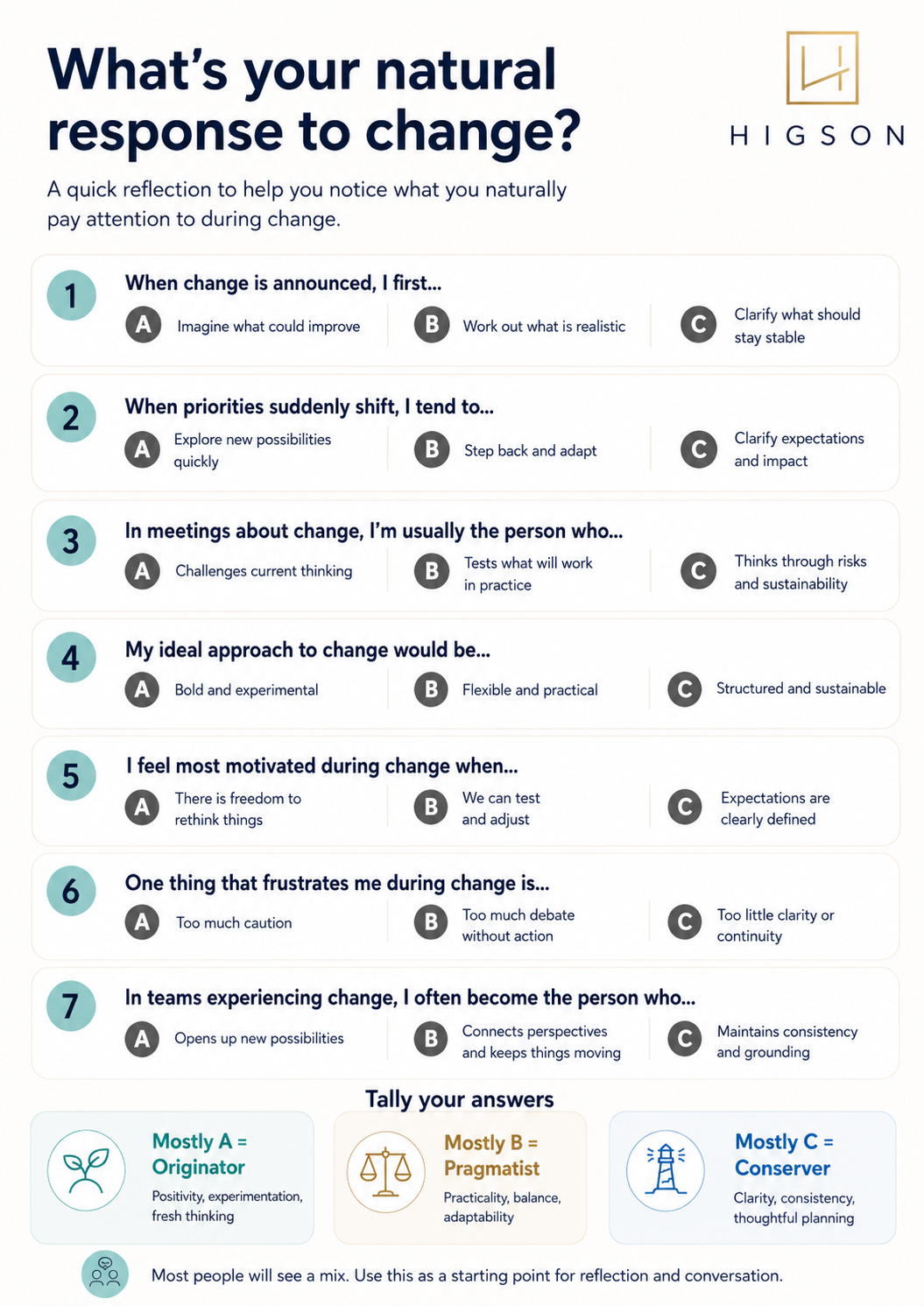
The point of this assessment isn’t to put yourself in a box, it’s to build self-awareness around how you tend to respond when change feels fast, uncertain or high-pressure.
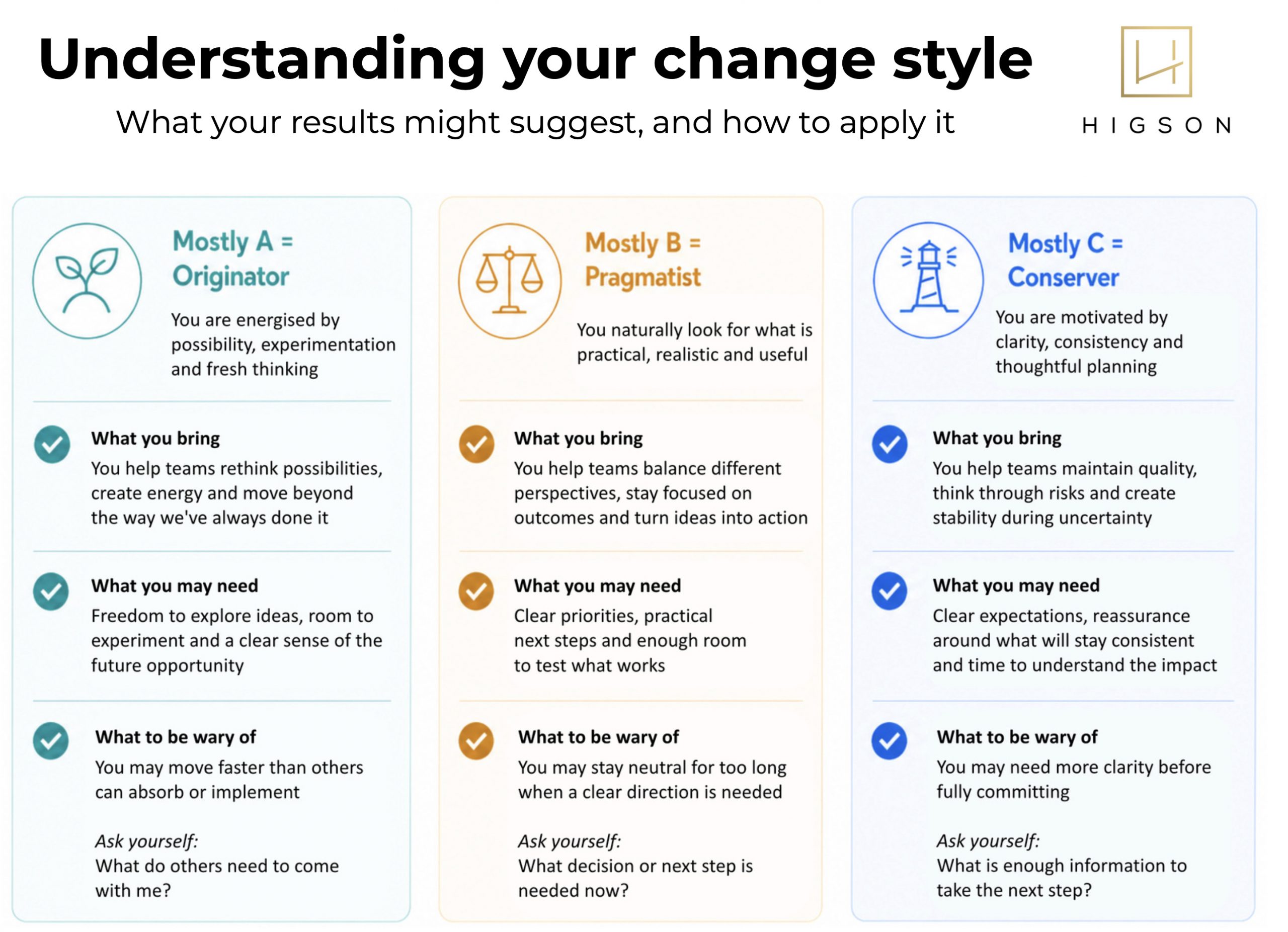
If you are a leader, we really encourage you to use this with your team. Ask them to complete the assessment individually, and turn it into a discussion:
For example, Originators may value freedom to explore ideas. Pragmatists may value practical clarity and room to test what works. Conservers may value consistency, reassurance and time to think through the impact.
By doing this, it makes it easier to create the optimal conditions for different people to navigate change well together.
Opportunity is the fourth and final foundation for change readiness.
And it might sound simple, but during busy periods it is often the part that gets overlooked.
Pressure builds, priorities blur, and a new change lands before people have had time to process the last one.
We start ‘firefighting’, and before we know it, reflection time is removed, meetings multiply, and people are expected to absorb new information, adjust their behaviour and keep delivering at the same pace.
To help teams adapt sustainably, we recommend focusing on five simple habits.
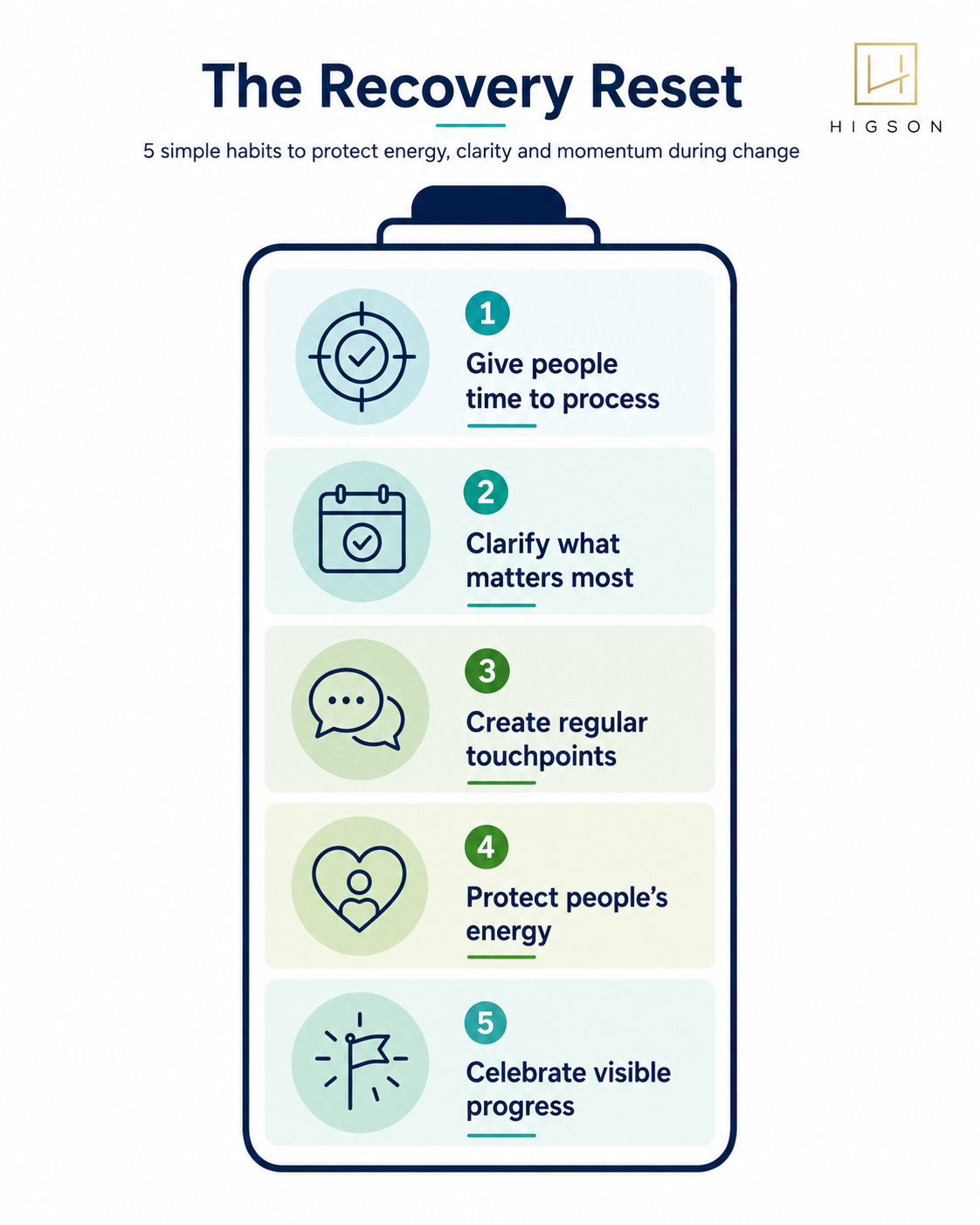
People often need to hear something more than once before it sinks in. Make space for questions and honest conversation about what the change actually means for them day-to-day.
When everything feels urgent, we can spread our time and energy too thinly.
Coach your team to focus time and effort on what matters – what to focus on each week, and what can wait.
This is even more impactful when you have a hybrid or remote work policy – read this blog for more tips to help you and your team work from home in a more productive way.
Build in a regular safe space to understand how the team is navigating the change.
It doesn’t have to be formal – even ten minutes at the end of a team meeting, a quick one-to-one, or a recurring “how is it going” at the start of each day. The goal is to know what’s working, and where people are stuck.
Here are some quick questions that could work well as a conversation starter:
Change takes effort. When people are carrying uncertainty or repeated disruption, leaders can help their team by helping them manage competing priorities, share clearer messages, or give space to pause and reset.
For more on how to start a wellbeing conversation with your team in a practical way, read this blog.
When the goalposts keep moving and the end goal still feels distant, it can be hard to acknowledge the progress you’re making.
Encourage a culture of appreciation – recognise small wins, or mindset and behaviour shifts. This helps remind people that their efforts make a difference.
And important to remember that not everyone likes to be recognised in the same way – read this blog for more on the different recognition languages.
Change is here to stay, so change fatigue at work is understandable. But it is not inevitable!
When leaders communicate clearly, understand different responses to change, and create recovery space, teams are better able to keep adapting without burning out.
The organisations that thrive will be the ones building cultures, leaders and mindsets that help people navigate change sustainably.
If you’re interested in helping your leaders and teams build stronger change mindsets, please get in touch.